
Structured WordPress development is often misunderstood.
It is not defined by tools, themes, or plugins.
It is defined by how a website is organised at a system level.
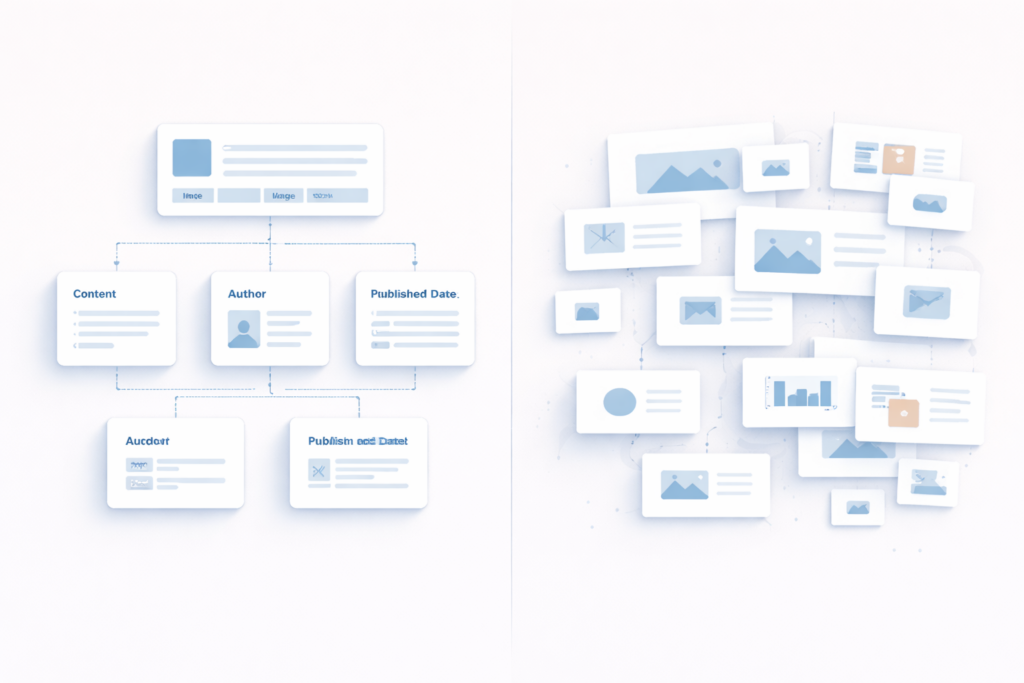
Most websites are built visually. Structured development approaches the website differently. It begins with how content should behave, not how it should look.
For a broader view of structural planning, see architecture.
What “Structured” Means in Practice
Structure defines how content is stored, connected, and displayed.
Defined content models
Content is organised into specific types, such as services, locations, or resources. Each type follows a consistent format.
Field-based content
Instead of relying on visual editors, content is broken into fields. This ensures information is stored predictably.
Separation of content and layout
Content is managed independently from design. Layouts are controlled through templates, not individual pages.
Why Most WordPress Development Is Not Structured
Many websites are built without defining structure first.
Visual-first approach
Development often begins with design. Pages are created visually without establishing how content should be organised.
Page-by-page builds
Each page is treated as a separate task. There is no shared system governing how pages should function.
Lack of standardisation
Content varies across pages, even when it represents the same type of information.
These patterns are closely related to the issues outlined in why most wordpress websites fail.
The Role of Structure in System Stability
Structured development creates predictable behaviour.
Consistency across content
Similar content types behave in the same way, reducing variation and improving maintainability.
Easier updates
Changes can be made at the template or system level rather than on individual pages.
Reduced dependency on tools
The system does not rely on specific plugins to function. Tools support the structure rather than define it.
For a deeper explanation of system behaviour, see systems.
How Structured Development Supports SEO
SEO is influenced by how content is organised.
Clear content hierarchy
Structured systems maintain consistent heading levels and page organisation.
Predictable metadata
Fields allow metadata to be managed consistently across all pages.
Strong internal relationships
Content can be linked logically, improving crawlability and topical relevance.
Structured Development vs Traditional Builds
Traditional builds prioritise speed and visual output.
Structured development prioritises system behaviour.
Traditional builds create pages.
Structured development creates systems that generate pages.
This distinction is closely tied to scalability, as explained in what makes a wordpress website scalable.
When Structure Is Missing
The absence of structure becomes visible over time.
Inconsistent content
Pages that should be similar begin to diverge.
Difficult updates
Simple changes require more effort because there is no consistent system.
Increasing complexity
As the website grows, managing it becomes more time-consuming.
This is often seen in websites that rely heavily on page builders, as explored in the hidden costs of using page builders for business websites.
Structure as a Foundation
Structured development is not an added layer.
It is the foundation of how the website operates.
When structure is defined early, the website can grow without increasing complexity.
Structured WordPress development is not about how a website looks at launch.
It is about how it behaves over time.