
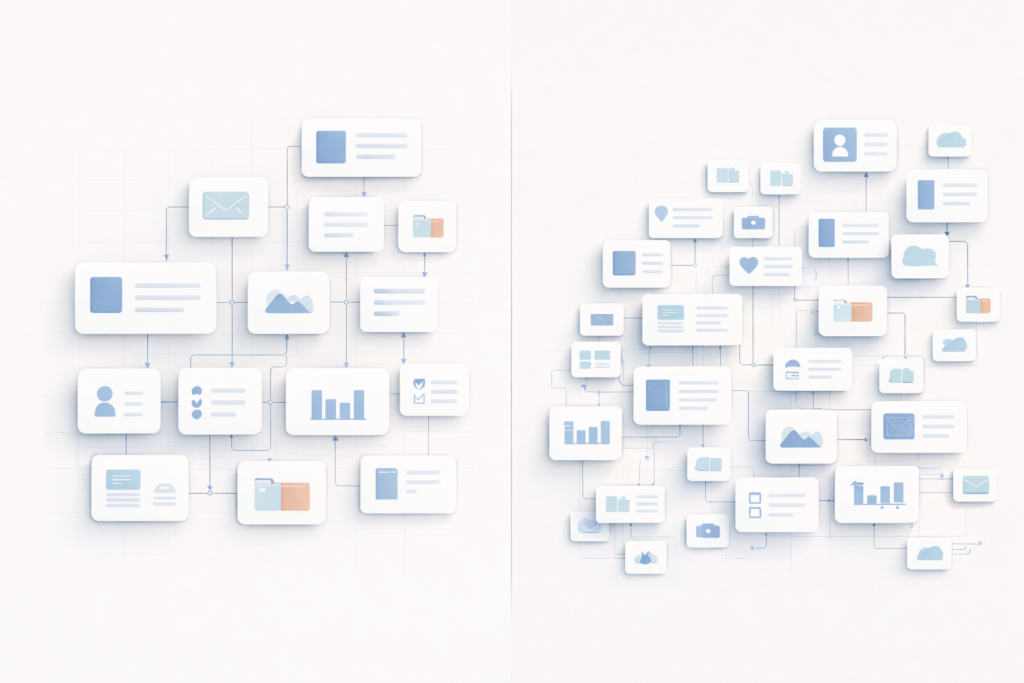
Most WordPress websites are not designed to scale.
They are built to launch.
This distinction is often overlooked at the beginning, but it becomes clear as the website grows. New pages become harder to create, changes take longer, and small updates begin to affect unrelated parts of the system.
Scalability is not something added later.
It is determined by structure from the start.
For a broader view of how structure is defined, see architecture.
What “Scalable” Actually Means in WordPress
Scalability is often misunderstood as traffic capacity.
In practice, it refers to how easily a website can grow without increasing complexity.
Consistent content structure
A scalable website uses defined content models. Similar types of content follow the same structure, making them predictable and repeatable.
Reusable templates
Templates are not created per page. They are designed once and reused across content types, ensuring consistency.
Controlled flexibility
Editors can manage content without changing layouts or logic. This reduces inconsistency over time.
Why Most WordPress Websites Don’t Scale
Most websites are assembled without considering how they will grow.
Page-by-page construction
Each page is built individually, often using page builders. This introduces variation where consistency is needed.
No defined content model
Content is stored differently across pages. Without a standard structure, scaling becomes inefficient.
Increasing reliance on plugins
As new requirements emerge, additional plugins are introduced. Over time, this increases dependency and complexity.
These patterns are closely linked to the issues outlined in why most wordpress websites fail.
The Structural Requirements for Scalability
Scalability is a result of deliberate architectural decisions.
Defined content types
Content should be grouped into clear types, such as services, locations, or resources. Each type follows a consistent structure.
Field-based content
Instead of relying only on visual editors, content is structured into fields. This ensures consistency across all entries.
Relationships between content
Content should connect logically. For example, services may relate to locations or case studies. These relationships allow the system to expand without duplication.
How Scalability Affects SEO
Scalability and SEO are directly connected.
Consistent page structure
Search engines rely on predictable patterns. Structured templates ensure headings, metadata, and hierarchy remain consistent.
Efficient indexing
When content follows a clear structure, it becomes easier for search engines to crawl and understand.
Scalable internal linking
Structured systems make it easier to create logical internal links, strengthening overall site architecture.
For a deeper explanation of system behaviour, see systems.
The Cost of Not Designing for Scalability
Websites that are not scalable do not fail immediately.
They become inefficient over time.
Slower content updates
Adding or editing pages requires more effort, often involving layout changes instead of simple content updates.
Increased maintenance
More plugins, more exceptions, and more inconsistencies increase the likelihood of issues.
Structural limitations
Eventually, the website reaches a point where meaningful changes become difficult without rebuilding.
This is often when businesses begin considering whether to rebuild instead of patching.
Scalability Is a Structural Decision
Scalability is not achieved by adding tools.
It is achieved by defining structure.
When content is organised, templates are consistent, and relationships are clear, a website can grow without becoming more complex.
A website that cannot scale will eventually need to be rebuilt.
A website with structure can continue to evolve without losing stability.