Search is no longer only about where a website ranks. Increasingly, it is also about whether search engines and AI systems can find, understand and make use of what a business publishes.
For years, we had a fairly straightforward picture of search visibility.
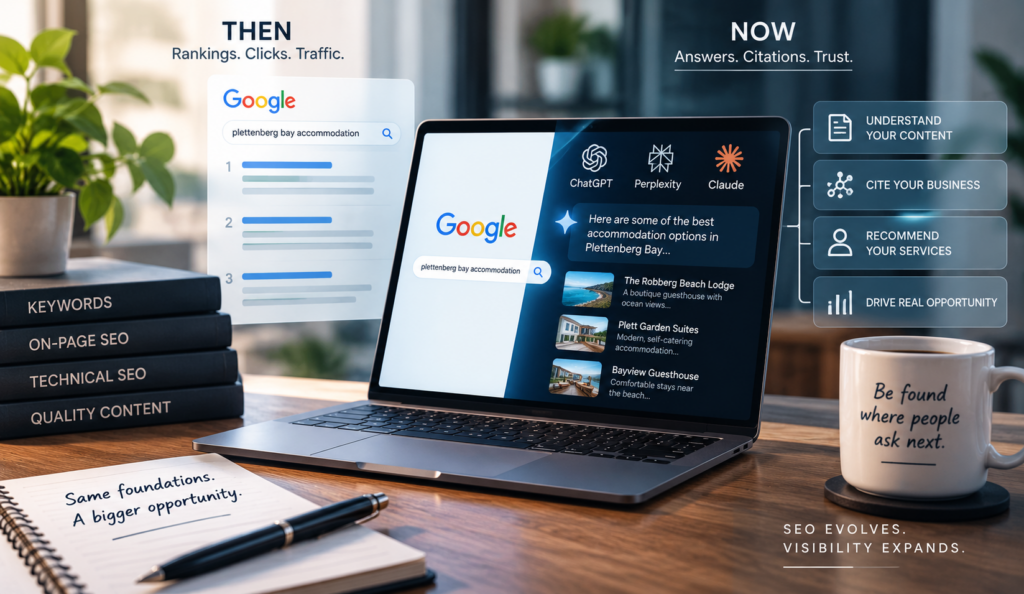
Someone searched Google. Google returned a list of results. Businesses competed to appear as close to the top as possible.
Rank well, earn the click and bring the visitor to your website.
Then generative AI changed the way people could search.
Someone can now ask a detailed question and receive an answer compiled from several sources without necessarily visiting a website first. Google’s AI Overviews and AI Mode are part of that shift, while other AI platforms can research, compare and recommend without looking anything like the traditional page of blue links.
Understandably, this has led to plenty of predictions about the death of SEO.
I don’t see it that way.
AI search hasn’t removed the need to be visible. It has made visibility a much bigger subject.
The foundations of SEO haven’t gone anywhere
A whole new vocabulary has grown around AI search, particularly AEO and GEO. Along with it have come plenty of claims that businesses now need a completely different technical playbook if they want to appear in AI-generated results.
Google’s own guidance is far less dramatic.
For its generative AI search features, the familiar SEO fundamentals still apply. A page needs to be accessible and indexable. There is no special AI schema that guarantees inclusion, and businesses don’t need to create a collection of new machine-readable files simply because AI is now involved.
When you think about it, that’s logical.
Before any system can use your information, it needs to be able to find and understand it.
A badly structured website doesn’t suddenly become easier to crawl because AI has arrived. Thin content doesn’t become useful because we call it GEO. And information buried where search engines struggle to reach it is still information they may never find.
Technical SEO, sensible site architecture, internal linking and genuinely useful content still form the foundation.
What has changed is what can happen once that information has been found.
Ranking is no longer the entire journey
For a long time, we could describe the search journey rather neatly:
Search → Ranking → Click → Website
That journey still exists.
But AI-assisted search introduces another possibility:
Question → Retrieval → Synthesis → Mention or Citation → Decision
And that’s where things become interesting.
A business could now influence someone’s decision without that person immediately visiting its website.
At the same time, ranking well in conventional search doesn’t necessarily mean a business will be included when an AI system constructs an answer.
So there is a genuine reason to start paying attention to AI visibility. We just don’t need to declare traditional SEO dead in order to do it.
Measurement is beginning to change too.
In June 2026, Google introduced dedicated Generative AI performance reporting in Search Console. Website owners can see impressions associated with generative AI features, which pages appeared and how that visibility changes over time. Google says the reporting was rolled out globally by the end of August.
For me, that’s one of the more interesting developments.
We are beginning to move from “Are we appearing in AI search?” to having actual data we can investigate.
Being found isn’t necessarily the same as being chosen
This is where AI visibility becomes particularly interesting.
Imagine a local estate agency publishes a genuinely useful page explaining the costs involved in buying property in its area.
Google can crawl it. The page can be indexed. Technically, it is available.
Now somebody asks an AI system:
“What should I budget for when buying a R4 million property in this area?”
The system needs more than a collection of available webpages.
It needs information it can use to build a useful answer.
Which sources are relevant? Which contain specific information? Which can be interpreted clearly? And which are worth citing?
Research from Ahrefs gives us an interesting glimpse into that difference. In an analysis of 1.4 million prompts, it found that ChatGPT could retrieve considerably more URLs than it ultimately cited. In that dataset, only around half of the retrieved URLs went on to become citations.
For marketers, that raises a useful point.
Making information available to an AI system is one challenge. Publishing something useful enough for it to draw upon is another.
Please don’t start writing for robots
This is where I think AI optimisation could easily head in the wrong direction.
Every major change in search seems to produce a new list of tricks.
Add this markup. Use this phrase. Create this file. Structure every paragraph this way. Mention these entities.
We’ve been here before.
Google’s own guidance around generative AI search continues to emphasise useful, original content rather than an entirely new set of optimisation tricks.
That doesn’t mean there is nothing new to learn.
It means the answer probably isn’t making our websites increasingly unnatural in the hope that machines will like them.
Businesses need to publish information worth finding in the first place.
Real expertise. Useful comparisons. First-hand knowledge. Clear explanations. Accurate information. Evidence. And proper answers to the questions customers actually ask.
For a local business, that could be knowledge that only somebody who works in that town or industry is likely to have.
For a software company, it could be detailed implementation advice learned through experience.
For a professional services business, it might simply mean answering the difficult questions prospective clients really want answered instead of publishing another page full of marketing language.
AI can already produce an extraordinary amount of generic content.
I suspect that makes the things it can’t easily manufacture more valuable.
Your website isn’t your entire digital presence
There’s another part of AI visibility that I think businesses need to pay attention to.
Your website isn’t the only place where your business exists online.
Search engines and AI systems may encounter a brand through directories, publications, reviews, forums, social platforms, videos and other websites.
That’s one reason third-party AI visibility platforms are beginning to look beyond rankings and report on things such as mentions, citations and share of voice.
Ahrefs, for example, now talks about AI visibility in terms of mentions, citations, impressions and AI share of voice.
These shouldn’t be confused with Google’s own metrics. Third-party platforms don’t have access to Google’s internal ranking or AI systems, and Google itself has cautioned against treating their data as though they do.
But I think the broader principle is useful.
A business’s visibility online has never really belonged to a single webpage or ranking.
AI search is simply making that easier to see.
The website remains the foundation a business controls. Around it sits a much larger collection of references, profiles, reviews, mentions, content and other signals that help establish who the business is and what it knows.
That leads to a different question.
Instead of asking only:
“Does our website rank?”
we can also ask:
“When somebody researches our service, product, industry or location, are we part of what they find?”
SEO is becoming part of a bigger visibility picture
None of this makes SEO less important.
Quite the opposite.
Technical SEO helps search systems discover information. Good content gives them something worthwhile to discover. Clear website architecture provides context. Accurate business information helps establish who the organisation is. Third-party references extend that presence beyond what a company says about itself.
Then analytics help us understand whether any of it is actually working.
AI visibility adds another piece to that picture: whether generative systems encounter and use that information when helping someone answer a question or make a decision.
I don’t think these need to become competing disciplines.
They’re increasingly connected parts of the same job: helping a business become easier to find and understand online.
The ranking was never really the goal
Perhaps AI search is reminding us of something that SEO has occasionally lost sight of.
Ranking number one was never the actual business objective.
Neither is appearing in an AI-generated answer.
A business ultimately wants to be found by the right people, understood, trusted and chosen.
For more than two decades, search engines have played an enormous role in connecting those steps.
Now AI systems are becoming another part of that journey.
The interface is changing. How people discover information is changing. And some of the ways we measure visibility will need to change with them.
But the basic job hasn’t disappeared.
If anything, it has become broader.
The future of SEO isn’t simply about optimising for a different kind of search result.
It’s about understanding what it now means for a business to be visible.